
Will a VSD air compressor save energy in your plant?
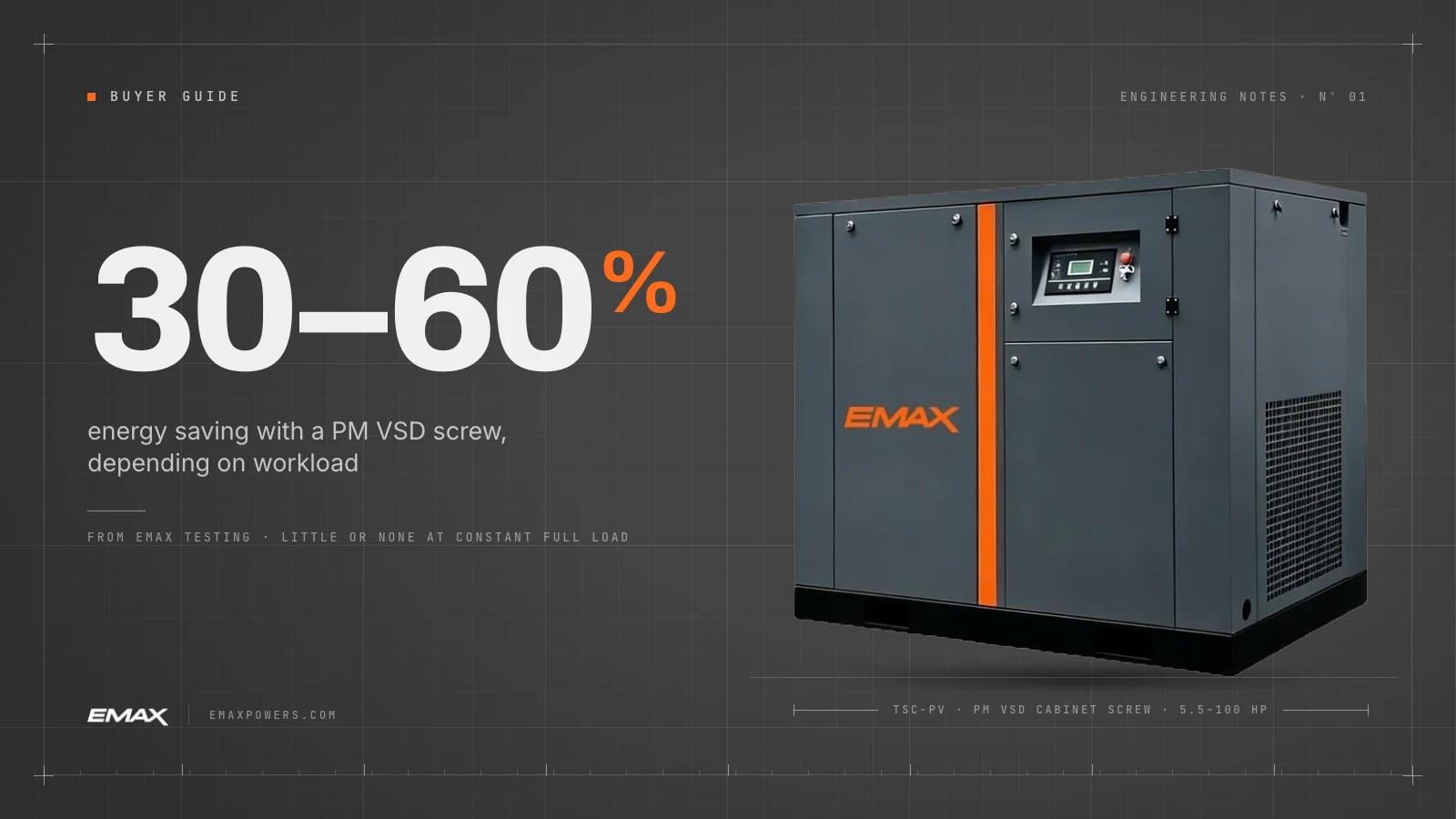
A variable-speed drive (VSD) air compressor saves energy when a site's air demand rises and falls. EMAX's own testing puts the saving of its PM VSD cabinet screw compressors at 30–60 % against an equivalent fixed-speed unit, depending on workload. At near-constant full load the saving falls away, so the load profile decides whether a VSD pays off.
Where a fixed-speed compressor loses energy
A fixed-speed screw compressor runs its motor at one speed and controls output by loading and unloading. When demand drops it unloads, and an unloaded machine still draws a real share of full power while delivering no air. On a site where demand moves through the day, those unloaded minutes add up on the electricity bill.
A variable-speed drive changes motor speed to match demand minute by minute, so the compressor delivers about as much air as the site is using. On the EMAX PM VSD cabinet line the inverter holds outlet pressure constant, and soft start limits inrush current.
The permanent-magnet motor adds a second gain. The motor and the airend share a single shaft, with no coupling or gearbox and so no transmission losses. A permanent-magnet motor also holds its efficiency better at part load than a standard induction motor, and part load is where a VSD spends most of its time.
Why the saving is a range: 30–60 % depending on workload
The condition is part of the figure. Where a site lands in the band depends on how much its demand varies and how low its average load sits:
- Wide demand swings, low average load. These sites sit high in the band. Typical sources of variable demand: shifts that ramp up and down, mixed tooling, food and beverage lines with peaks and idle periods.
- A normal workshop duty cycle at about 60 % average load. This is the floor of the band, about 30 %, which is what the EMAX TCO calculator returns at that load.
- Near-constant full load around the clock. The saving shrinks toward zero, and the inverter's own losses can make a VSD marginally less efficient than a well-matched fixed-speed machine.
How to read your load profile and run the numbers
Before comparing machines, collect four things about the site, whether it is your own operation or a customer's:
- Average load factor. Average air demand as a share of the compressor's nameplate capacity. In the calculator, this is the only input that changes the percentage saving.
- Operating hours. Hours per day and days per year. They decide how much money the percentage is worth.
- Shape of demand. One steady process, or shifts, breaks and weekends? The more demand varies, the more variable speed is worth.
- Electricity tariff. The rate per kWh from the actual utility bill, not a regional average.
An installed fixed-speed machine that logs running and loaded hours gives a first indication of the load profile; a logged demand survey over a representative week gives a firmer one.
The EMAX TCO calculator then compares a PM VSD with a fixed-speed unit on load/unload control and projects the energy cost of each, over five years by default. Its formulas are modelled on CAGI Performance Verification Datasheets, US DOE Better Plants benchmarks and Compressed Air Challenge guidance. Inputs are power in HP, load factor, hours per day, days per year and a tariff in USD, EUR, AUD, NZD or CNY. Its three load presets show how strongly load factor drives the answer:
- Variable, 40 % load: 38.5 % saving.
- Typical, 60 % load: 29.8 %.
- High, 90 % load: 7.3 %.
At 100 % load the calculator shows a slightly negative saving rather than hiding it. The 30–60 % band comes from EMAX's own testing; the calculator's results are estimates for preliminary evaluation. Leakage, piping pressure drop, receiver capacity, ambient temperature and the pressure setting all change the real result, so confirm any desk estimate with a site survey.
When fixed speed is the better buy
A site that runs one constant process at or near full load, shift after shift, leaves little demand variation for variable speed to exploit. There, a correctly sized fixed-speed machine can be the better economics. The EMAX fixed-speed cabinet screw line covers 7.5–250 HP and is built for sites that consume compressed air continuously at a steady rate: fixed-speed control with no inverter on board, and a large cooler and oil tank for round-the-clock duty.
Start with the site's demand curve. Once it is on paper, the choice of drive usually follows.
Key facts
- PM VSD cabinet line energy saving: 30–60 % against an equivalent fixed-speed unit, depending on workload, from EMAX's own testing. At near-constant full load the saving falls away.
- At a typical 60 % average load the saving is about 30 %, the floor of the band (29.8 % in the EMAX TCO calculator).
- The PM VSD cabinet range has 12 models, from TSC-5.5PV (5.5 HP / 4 kW, delivers 0.48 m³/min) to TSC-100PV (100 HP / 75 kW, delivers 11.45 m³/min), all at 10 bar (1.0 MPa), with 13 bar on request.
- Most popular tiers: TSC-30PV (30 HP / 22 kW, delivers 2.91 m³/min), TSC-50PV (50 HP / 37 kW, delivers 5.15 m³/min) and TSC-100PV.
- IE4 permanent-magnet motor, inverter control that holds outlet pressure constant, and soft start.
- AS1210-certified pressure vessel as standard. AS1210 is an air-receiver (pressure-vessel) approval: it covers the vessel, not the airend or the complete compressor. The screw range is CE-marked under a declaration of conformity.
- AirSmart IoT-ready via RS485: New Zealand pilot, rolling out 2026.
FAQ
How much energy does a VSD air compressor save?
EMAX's own testing puts the saving of its PM VSD cabinet screw compressors at 30–60 % against an equivalent fixed-speed unit, depending on workload. Sites with wide demand swings and a low average load sit high in the band; a typical workshop at about 60 % average load sits at the floor, about 30 %.
Is a VSD compressor worth it if my plant runs at full load all day?
Usually not. At near-constant full load there is little demand variation for variable speed to exploit, and the inverter's own losses can make a VSD marginally less efficient than a correctly sized fixed-speed machine.
How do I find a site's average load factor?
Average load factor is average air demand divided by the compressor's nameplate capacity. If an existing fixed-speed machine logs running and loaded hours, comparing the two gives a first indication; a logged demand survey over a representative week gives a firmer one.
What is the difference between a PM VSD and a standard VSD?
A PM VSD pairs variable speed with a permanent-magnet motor. On the EMAX PM VSD cabinet line the motor and airend share one shaft, so there is no coupling or gearbox loss, and a permanent-magnet motor holds its efficiency better at part load than a standard induction motor.
Put a site's hours, tariff and average load into the TCO calculator and read the PM VSD screw compressor guide for the full energy case. Power, flow and pressure for all 12 models are on the PM VSD cabinet screw series page, and certificate numbers and scope are on the certifications page. EMAX POWER is a Shanghai air compressor brand and exporter, supplying distributors and importers in 30+ countries since 2001. To size a PM VSD against a real demand profile, contact the EMAX engineering team.